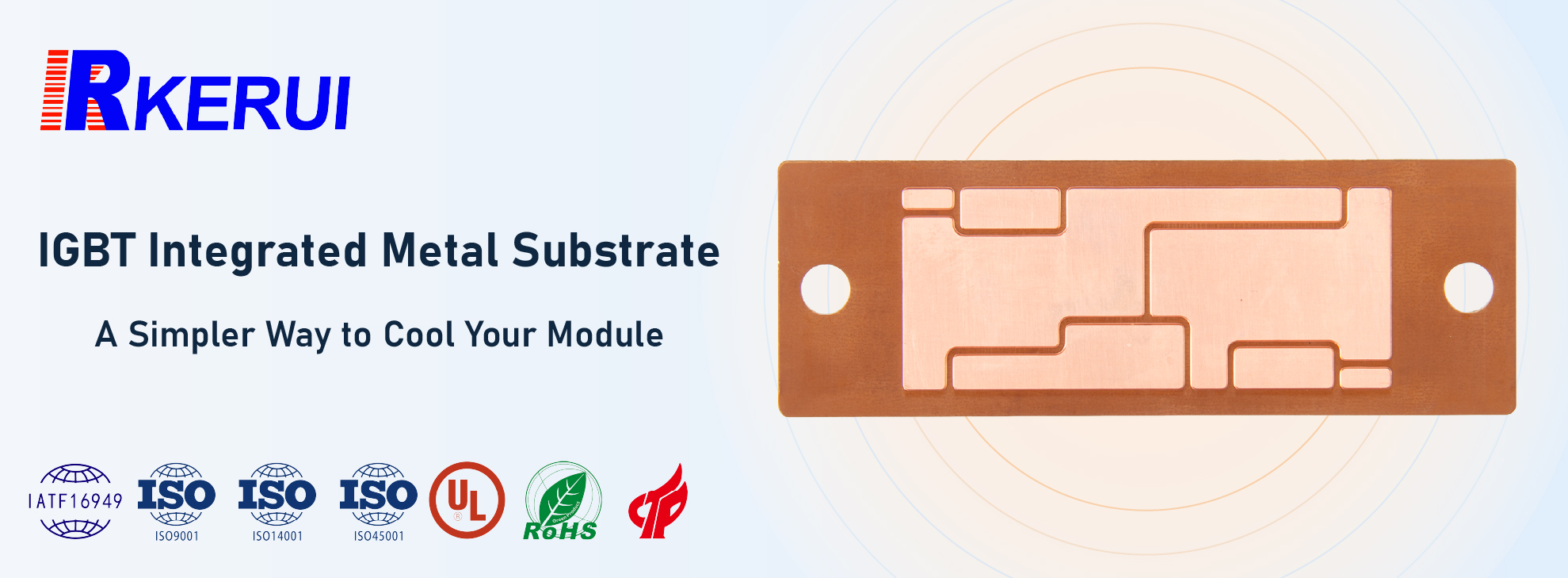
IGBT Integrated Metal Substrate: A Simpler Way to Cool Your Module
One metal board in place of a DBC substrate and copper plate.
Insulated gate bipolar transistors,better known as IGBTs, are the switches behind many of the machines that moveand convert power: motor drives, solar inverters, welding equipment, and theelectric drive systems in EVs. They handle large currents at high voltage, and every time they conduct or switch, part of that energy is lost as heat.
That heat has to go somewhere. If it stays inside the module, the IGBT runs hotter, wears out faster, and may eventually fail. A big part of the cooling job falls to the substrate, the layer that sits under the chips and carries heat away from them.
This article explains how heat travelsthrough an IGBT module, how the common DBC substrate plus copper plate setupworks, and what an IGBT integrated metal substrate is: a single metal-based board designed to do the work of both parts.

Why IGBT Modules Need Good Cooling
An IGBT is never perfectly efficient. Itloses some power while it is switched on (conduction loss) and some every timeit switches between on and off (switching loss). Those losses turn into heatconcentrated in a very small area: the silicon chip.
Think of a computer processor. Without aheat sink and a fan, it would overheat within seconds. An IGBT module issimilar, only it handles much more power. Temperature matters for threereasons:
Heat shortens life. In power electronics, operating temperatureis closely tied to how long a module lasts. A cooler module generally lives longer.
Heat limits performance. If the chip cannot shed heat fast enough, the system may have to reduce output to protect itself.
Temperature swings add stress. Equipment heats up under load and cools down when idle. Each cycle makes materials expand and contract, and parts made of different materials do so at different rates, which puts stress on the joints between them.
This is why designers pay closeattention to the path heat takes out of the module.
How Heat Travels Through an IGBT Module
Heat leaves an IGBT module step by step,moving from the hottest point to the coolest:
The chip (silicon or silicon carbide) generates the heat.
The heat passes through a solder layer into the substrate.
The substrate spreads the heat and passes it down to the base layer (a copper plate in many designs).
The base passes the heat through a thin layer of thermal interface material to the heat sink.
The heat sink releases it into the air or into a liquid coolant.
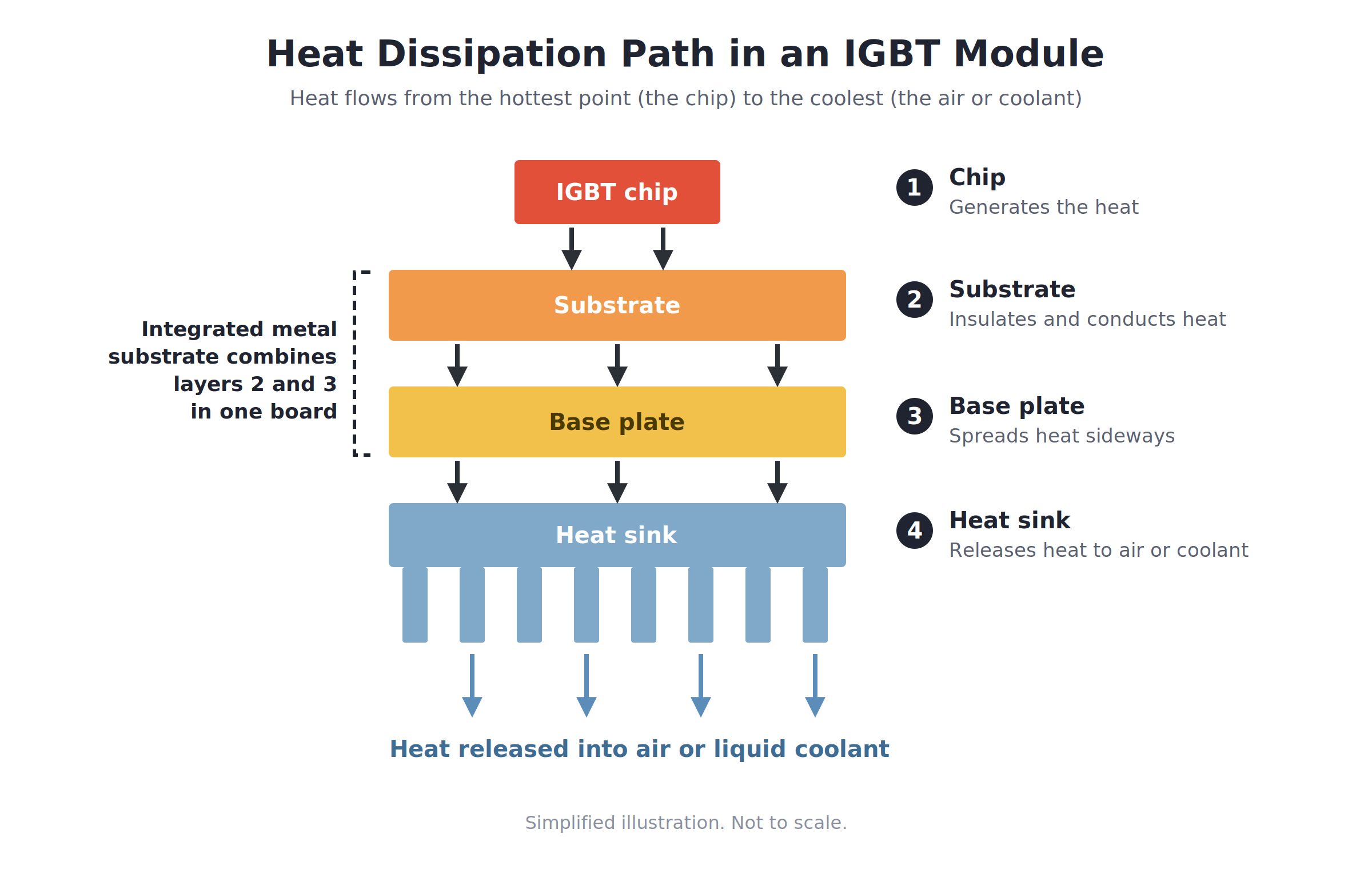
The substrate has two jobs at once. Itmust insulate electrically, so the high voltage on the chip circuit does notreach the heat sink. And it must conduct heat well, so the chip stays cool.These two goals often pull in opposite directions, because many good insulators are poor heat conductors. In general,everylayer and every joint along thepath adds some resistance to heat flow, so the design of the substrate and the parts around it has a direct effect on cooling.
Small details along this path mattermore than they might seem. The surface that touches the heat sink needs to beflat, because even tiny air gaps block heat, and air is a poor conductor. Thatis one reason manufacturing precision, not just material choice, shapes howwell a module cools in real use.
The Common Approach: DBC Substrate + Copper Plate
Most IGBT modules on the market use a two-part setup.
DBC substrate. DBC stands for DirectBonded Copper. It is a ceramic plate (commonly alumina or aluminum nitride)with copper bonded to both faces. The top copper is etched into the circuitpattern that the chips sit on. The ceramic in the middle provides electricalinsulation while still letting heat through.
Copper plate. The DBC substrate is thenattached to a thick copper plate, usually by soldering. The plate spreads heatsideways before it reaches the heat sink, gives the module mechanical strength,and carries the holes used to fasten the module to the cooler.
This combination is proven and widelyused. The trade-off is that it is made of two separate parts that must beproduced, joined, and kept flat and aligned. The solder joint between them isalso one more layer in the heat path, and one more place that sees stress astemperatures rise and fall.
What Is an IGBT Integrated MetalSubstrate?
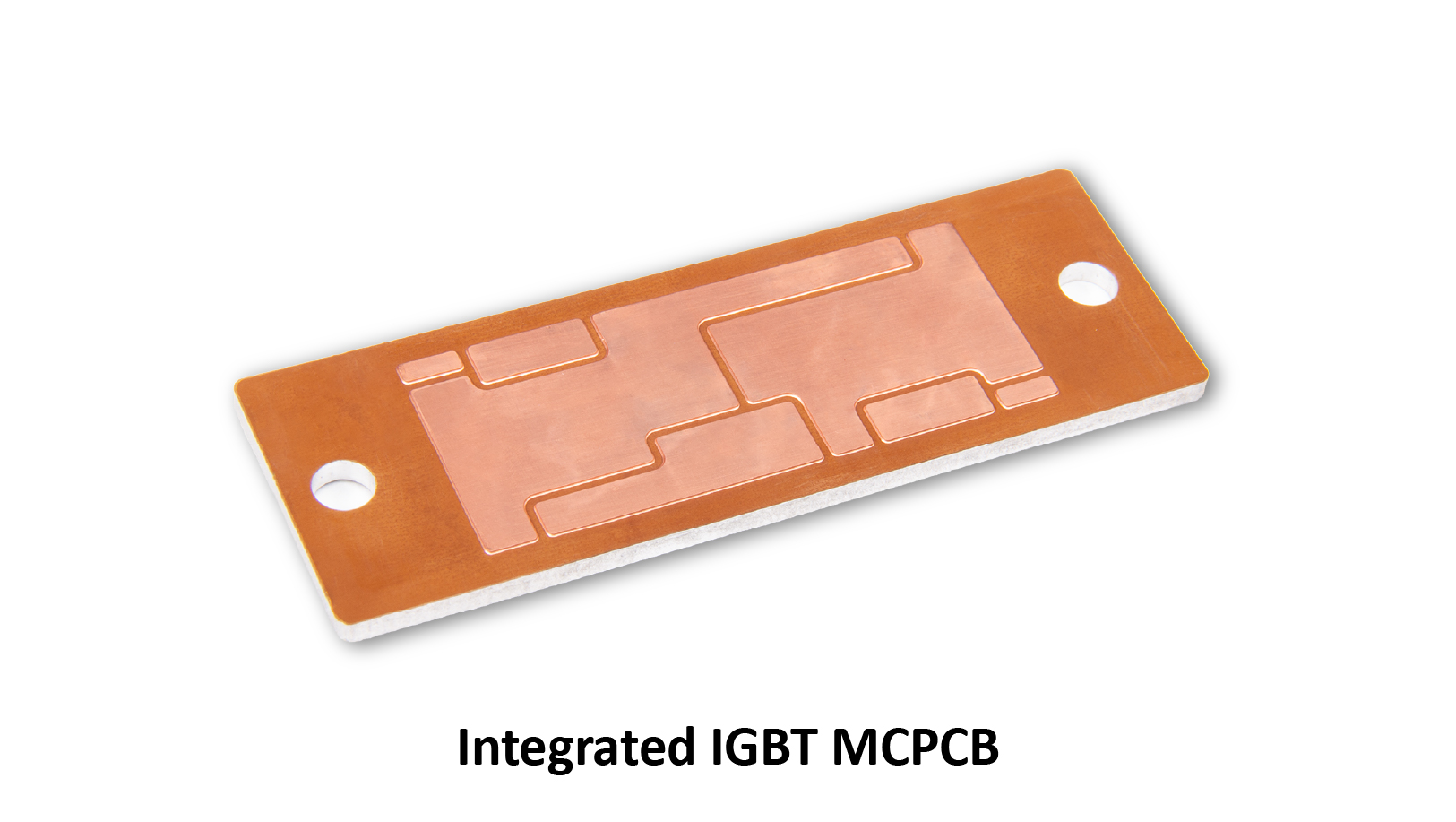
An IGBT integrated metal substrate is asingle board that takes over the roles of both the DBC substrate and the copperplate. A ceramic insulating layer is pressed directly onto a copper base, sothe module sits on one board instead of two parts joined together.
Its structure is easy to picture fromthe bottom up:
Copper base. Spreads heat quickly across a wide area and provides the mechanical backbone, much like the copper plate does.
Silicon nitride ceramic insulating layer. Keeps the chip circuit electrically isolated from the base while still passing heat downward. Ceramic also withstands high voltage, which is why it is widely trusted in power modules.
Pressed bond. The ceramic and the copper base are pressed together into a single board.
Copper circuit layer. The copper pattern on top, where the IGBT chips are mounted and connected.
This is where the word"simpler" comes from. With one board instead of two parts:
there is one fewer component to source, handle, and assemble;
the ceramic layer and the copper base are pressed once into asingle board, rather than being two parts that are joined later;
the circuit layout is made directly on the board, so its shape, size, and mounting holes can be designed together.
A fair note on choosing: the rightsubstrate depends on the application. Some designs, especially those withdemanding insulation or thermal requirements, may still be best served by atraditional DBC substrate with a copper plate. When comparing options, it helpsto look at five things: the current and power level, the voltage and insulationneeds, the heat that has to be removed, the available space and mountingmethod, and the production volume. Sharing these with your board manufacturerearly makes it much easier to find the right fit.
Where Is It Used?
IGBTs appear wherever electric power has to be controlled efficiently, and so does the need to cool them. Typical fields include:
Motor drives and frequency inverters. Controlling the speed of pumps, fans, compressors, and factory machinery.
Electric vehicles. Traction inverters and onboard power conversion, where space is tight and heat is high.
Solar and energy storage inverters. Converting DC from panels or batteries into AC, often outdoors and running for many hours a day.
Welding equipment. Delivering high current in rapid pulses, which makes thermal cycling a real concern.
Servo drives and industrial automation. Precise, repeated motion control that keeps IGBTs working through frequent load changes.
What to Check When Choosing a Metal Substrate Supplier
A metal substrate for IGBT use is not aneveryday PCB, and every IGBT design is different, so a board that fits onemodule rarely fits another. A few practical questions are worth asking beforeyou place an order, and here is how Kerui answers them:
Can they customize?
Circuit pattern, outline, and mountingholes should follow your drawing, not a fixed catalog. Customizationand flexibility are our focus. We work from your drawing to match theboard to your module, and we are happy to discuss material options such as thermal conductivity.
Do they have metal substrate experience?
Processing a thickmetal base is different from making standard FR4 boards. Metal corePCBs are one of Kerui's core product lines.
Which certifications do they hold?
For automotive and industrial work, these show that the factory runs under controlled processes. Kerui is certified to IATF 16949, ISO 9001, and UL.
How do they check quality?
Ask about flatness checks, insulation testing, and thermal performance data for the board you need.
Do they offer engineering support?
A manufacturer who reviews your design before production can catch problems early and save you aredesign. Send us your drawing or requirements, and our team will go through them with you before quoting.
FAQ
What is an IGBT integrated metalsubstrate?
It is a single board made of a copper base, a silicon nitrideceramic insulating layer, and a copper circuit layer, pressed together into onepiece. It replaces the combination of a DBC substrate and a copper plate in anIGBT module.
What is the difference between a DBCsubstrate and a metal substrate?
A DBC substrate is a ceramic plate with copperon both faces and is usually paired with a separate copper plate. An integratedmetal substrate presses the ceramic insulating layer directly onto a copperbase, so the insulating layer and the base are combined in one board.
How does an IGBT module dissipate heat?
Heatflows from the chip through the substrate and base layer into a heat sink,which releases it into the air or a liquid coolant. Each layer along the wayaffects how easily the heat can escape.
Can an integrated metal substratereplace DBC in every design?
Not necessarily. The right choice depends on powerlevel, insulation requirements, thermal needs, and space. It is best to discussyour specific requirements with the manufacturer.
Can the board be customized?
Yes.Circuit pattern, outline, and mounting holes can be made to your drawing.Contact us with your requirements to discuss the details.
Conclusion
Good cooling is one of the main factorsin how long an IGBT module lasts and how well it performs. The substrate sitsright in the heat path, so how it is built matters. The familiar DBC substrateplus copper plate is a proven solution, while an IGBT integrated metalsubstrate offers a simpler structure by combining the two parts into one board.
